Demand Broken Down: Ross and Rachel break down demand
Your electric bill measures two different types of energy usage:
Energy (kWh) is the total amount of electricity you use over time, like the miles on your car’s odometer.
Demand (kW) is the rate at which you use electricity at any one moment, like your speedometer.
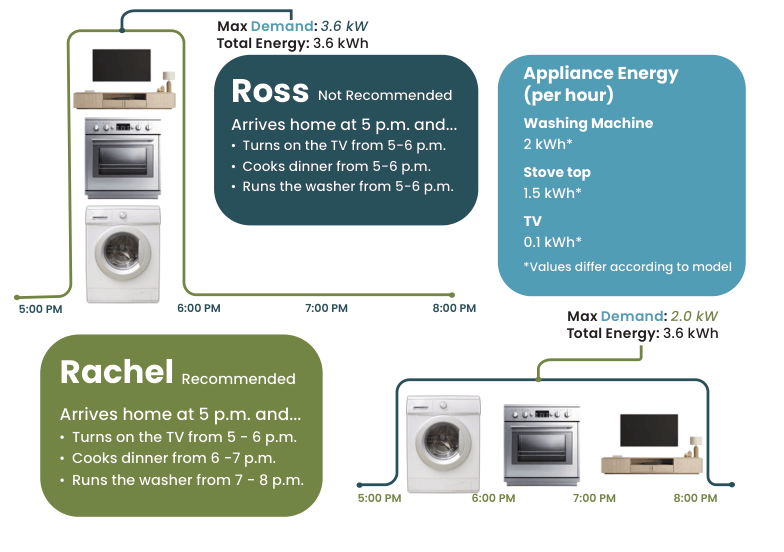
Two members can use the exact same amount of energy in a month and still have very different demand, just based on timing. Here’s an easy way to picture it. Say Ross and Rachel both get home at 5 p.m., and both use the same appliances for the same total energy that evening: 3.6 kWh.
Ross cooks dinner, washes clothes, and watches a show all between 5 and 6 p.m. Running everything at once pushes his max demand to 3.6 kW.
Rachel spreads the same tasks out. Dinner from 5 to 6, laundry from 6 to 7, and her show from 7 to 8. Same total energy, same appliances, but her max demand comes in at just 2 kW.
Same energy bill, very different demand, just because of timing. That matters because Itasca-Mantrap has to have enough capacity on the system to handle everyone’s highest demand,
even if it only lasts a few minutes.
The good news is that small shifts can make a real difference:
Nudge your thermostat a few degrees during peak hours
Run laundry and dishwashers later in the evening
Charge your EV overnight instead of right when you get home
Visit our "What is demand page" for more examples and to learn more about demand.